CBD oil for cats is sold as a hemp product for pets, but the FDA has not approved CBD for any use in animals, and research in cats is very limited. The little data that exists suggests cats process CBD differently from dogs. If you are thinking about it, talk to your veterinarian first, choose a product made for pets, and measure tiny amounts carefully by weight.
This guide covers what the research actually says, why cats need extra care, how to work out the math for your cat's weight, how to give CBD oil to a cat, and what to watch for. It is not medical advice, and it does not suggest CBD for any condition.
What research says about CBD and cats
Start with the official position. On its cannabis and CBD information page, the U.S. Food and Drug Administration says it has not approved cannabis for any use in animals and urges owners to discuss options for their pet with a veterinarian. In its consumer guidance, the FDA also lists the safety of CBD in pets as an open question it is still studying.
One of the few published studies that included cats came from veterinary researchers at Cornell University and other schools. It was published in 2019 in the journal Animals. The team gave eight healthy cats and eight healthy dogs a CBD-rich hemp product at 2 mg per kg of body weight, twice a day, for 12 weeks, and tracked bloodwork. A few findings stand out for cat owners:
- At the same mg per kg, the cats had much lower levels of CBD in their blood than the dogs did.
- The cats often showed licking and head shaking when the oil was given.
- One of the eight cats had a liver enzyme reading (ALT) that stayed above the normal range during the study.
- The authors described their safety results as preliminary. The study was small and had no comparison group.
That is a thin evidence base. It tells us cats are different, and that careful measuring and vet oversight matter. It does not tell us what amount suits any particular cat.
Why cats are not small dogs
It is tempting to take a dog chart and scale it down. Please don't. Vets already know that cats handle many medicines and household substances differently from dogs and people, which is why some products that are fine for dogs are off limits for cats. The Cornell results point the same way for CBD.
Cats are also small. A 10 lb cat weighs about 4.5 kg, so even a modest amount of CBD per kg is a very small volume of oil. Measuring errors that would not matter for a 70 lb dog can double what a cat receives.
Finally, cats are picky and sensitive to taste and smell. A strongly flavored oil may be refused or spat out, and flavorings made for people, such as peppermint oil, are not meant for cats. Stick to products made for pets.
How much CBD oil should I give my cat? The math
Only your vet can answer how much CBD oil your cat should get. What we can do is show you how to turn your vet's number into milliliters, because pet CBD oil labels list strength in milligrams (mg) per bottle, not per drop.
Start with the label. Our Pet Vet oil comes in a 30 ml bottle. The 750 mg bottle has 750 divided by 30, or 25 mg of CBD per ml. The 1500 mg bottle has 50 mg per ml. For cats, the lower strength is usually easier to measure because each 0.1 ml holds less CBD.
Next, convert your cat's weight to kilograms (divide pounds by 2.2) and multiply by the mg per kg figure your vet gives you. The table uses 1 mg per kg only because it makes scaling easy. It is not a recommended amount.
| Cat's weight | In kg | mg of CBD for each 1 mg/kg | ml of 750 mg oil (25 mg/ml) | ml of 1500 mg oil (50 mg/ml) |
|---|---|---|---|---|
| 6 lb | 2.7 kg | 2.7 mg | 0.11 ml | 0.05 ml |
| 8 lb | 3.6 kg | 3.6 mg | 0.15 ml | 0.07 ml |
| 10 lb | 4.5 kg | 4.5 mg | 0.18 ml | 0.09 ml |
| 12 lb | 5.5 kg | 5.5 mg | 0.22 ml | 0.11 ml |
| 15 lb | 6.8 kg | 6.8 mg | 0.27 ml | 0.14 ml |
If your vet suggests half a milligram per kg, halve the numbers. If they give you a flat amount instead, such as "2 mg", divide by the oil strength: 2 mg of the 25 mg/ml oil is 0.08 ml. Those volumes are tiny, so ask your vet or pharmacist for an oral syringe marked in 0.01 or 0.1 ml steps. Drops vary in size from one dropper to the next, so counting drops is not precise enough for most cats.
Capsules are a poor fit for most cats. Our Pet Vet capsules hold a fixed 10 mg each, so the amount cannot be adjusted in small steps the way an oil can, and capsules are hard to give to a cat in any case.
Choosing a CBD oil for your cat: a checklist
You will see plenty of "best CBD for cats" lists. Rather than trust a ranking, check the product against a few plain questions.
| What to check | Why it matters |
|---|---|
| Made for pets | Human products are often stronger and may contain flavorings or sweeteners not meant for animals. |
| Clear mg per ml | You cannot measure a vet's mg amount without knowing the strength. If the label only lists drops, skip it. |
| Short ingredient list | A carrier oil plus hemp extract is easier for your vet to review than a long blend. |
| Lab report available | A third-party certificate of analysis shows what a batch actually contained, including THC. |
| THC content | Full spectrum products contain a trace of THC. Ask your vet whether that is acceptable for your cat. |
| Flavor | A mild or natural flavor may be easier for a picky cat to accept than a strong one. |
How to give CBD oil to a cat
Go gently. A cat that has a bad first experience may refuse the bottle for good.
- On a small amount of food. Mix the measured oil into a teaspoon of wet food or a lickable treat, offered before the main meal, so you know all of it was eaten.
- By oral syringe. Hold your cat gently, slip the tip into the side of the mouth behind the canine teeth, and release the oil slowly. Never squirt it toward the throat.
- Never force it. If your cat fights, stop and try the food method or ask your vet for tips.
Expect some licking or head shaking, which the Cornell team also saw. If it seems to bother your cat, mention it to your vet. Clean the syringe after each use and store the bottle cool, dark and out of reach.
Start low, go slow, and keep notes
If your vet agrees to a trial, a simple routine helps you keep track.
- Share the product label and your cat's full list of medications and supplements with your vet.
- Start with the smallest amount your vet suggests.
- Give it at the same time each day, measured the same way.
- Change nothing else that week: same food, same treats.
- Keep a log of each dose: the date, the time, the mg and ml given, and anything unusual about your cat.
- Only adjust the amount on your vet's advice.
Stop and call your vet if you notice vomiting, diarrhea, drooling, unusual tiredness, unsteady walking, or a cat that stops eating. Because one cat in the Cornell study had a raised liver enzyme, ask your vet whether bloodwork makes sense if your cat will stay on CBD for a while.
Keep all THC products, including edibles, Delta-8 and THCA flower, far from cats. The FDA advises contacting your veterinarian, a local animal emergency hospital or an animal poison control center right away if a pet eats a cannabis product.
How Tahoe CBD fits in
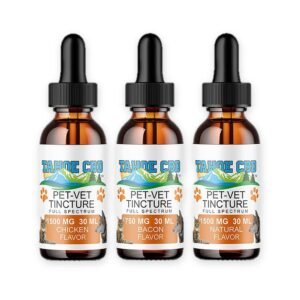
Our Pet Vet CBD oil is a full spectrum hemp extract sold in 30 ml bottles at 750 mg (25 mg per ml) and 1500 mg (50 mg per ml). Flavors are Natural and Chicken, with Bacon on the 1500 mg. For a cat, the 750 mg bottle makes small amounts easier to measure, but please ask your vet whether it suits your cat before you start. "Pet Vet" is the product name and does not mean a veterinarian approved it. Full spectrum means it contains other hemp compounds and a trace of THC, not just CBD. Our guide to full spectrum, broad spectrum and isolate explains what that means.
Hemp rules are changing too. From December 11, 2026, federal law caps final hemp products at 0.4 mg total THC per container, which may change full spectrum products across the industry. Our 2026 hemp law guide has the details as of October 26, 2026, and we will update our catalog to comply.
Lab reports are posted on our Lab Reports page when available. Ask us about any product and we will send the most recent report we have for it, or tell you plainly that it is not available yet. Browse all of our pet CBD products, read the companion guide on CBD dosage for dogs if you share your home with both, or call the South Lake Tahoe store at (530) 544-6666 with questions.